
The National Museum of Art in Bucharest
Updated: Apr 8
The problem with most travel guides to Bucharest is that they treat the city like a weekend stopover for cheap beer and stag parties. If you are looking for the "Little Paris" elegance that once defined this capital, you likely find yourself wandering Calea Victoriei, dodging crowds, and wondering where the actual soul of the city is hiding. Most visitors stare at the massive facade of the Palace of the Parliament and miss the far more sophisticated architectural triumph standing just a few blocks away.
The National Museum of Art of Romania (MNAR) is not just a gallery; it is the former Royal Palace. It is the site of grand balls, political coups, and a private collection that survived world wars and a revolution. If you want to understand the true aristocratic pulse of Bucharest, you don't look at the concrete of the communist era. You step inside the marble halls of the Royals.

The Royal Palace Secret: Why the Building is the First Masterpiece
Before you even look at a Rembrandt or a Romanian modernista, you must acknowledge the skin of the building itself. Most tourists walk past the statue of King Carol I and take a quick photo of the exterior. The insider move is to realize that the museum is split into distinct galleries: the National Gallery and the European Art Gallery.
The Royal Palace was rebuilt in the 1930s after a devastating fire, and it reflects the neo-classical sobriety preferred by King Carol II. When you walk through the entrance, pay attention to the monumental scagliola columns and the grand staircase. This was designed to intimidate and impress visiting dignitaries. If you look closely at the external walls of the wing facing the Atheneum, you can still find small pockmarks from bullets fired during the 1989 Revolution. It is a haunting juxtaposition: high art housed within a veteran of war.
For the luxury traveler, the "pain point" of museums is often the exhaustion of endless corridors. The secret here is to start with the Throne Hall. It is only open for special tours or specific days, but it represents the pinnacle of Romanian ceremonial life. Standing there, you can almost hear the rustle of silk gowns and the clinking of medals from a century ago.
Romanian Modernism: Beyond the European Canon
While the European Gallery houses impressive works by El Greco and Rubens, the real reason to visit is the Romanian National Gallery. This is where the "Information Gain" happens for an international traveler. You likely know Brancusi for his minimalist sculptures in Paris, but here, you see his early pieces like "The Prayer" which show his transition from classical anatomy to the soul-striking shapes that changed the world.
Nicolae Grigorescu is the name you need to remember. He is to Romania what the Impressionists were to France. His paintings capture a specific, luminous quality of the Romanian countryside that no longer exists. His "Ox Cart" series isn't just folk art; it is a study in light and the slow, rhythmic pace of Balkan life.
Insider tip: Head to the top floor of the National Gallery. Most people are tired by the time they get there, meaning you will often have the room full of Stefan Luchian’s floral masterpieces all to yourself. Luchian painted these while paralyzed, with the brush tied to his wrist. The intensity of the colors in his "Anemones" is almost visceral when viewed in the quiet of an empty hall.

The El Greco Mystery in the European Wing
The European Art Collection is surprisingly dense for a city that was so far removed from the traditional Grand Tour route. The core of this collection belonged to King Carol I, who was a man of immense taste and even greater wealth.
The highlight is undoubtedly the collection of works by El Greco. Romania holds one of the most significant collections of his work outside of Spain. Specifically, look for The Adoration of the Shepherds. The elongated figures and the haunting, flickering light are signature El Greco, but seeing them in the context of an Orthodox country like Romania feels different. There is a shared Byzantine heritage between the artist's Greek roots and Romania's spiritual history that makes these paintings feel "at home" here.
If you are a solo traveler seeking a moment of reflection, the Italian collection offers a quiet sanctuary. Unlike the Uffizi or the Louvre, you aren't fighting for a view. You can stand six inches away from a Bronzino or a Tintoretto and study the brushwork without a security guard ushering you along or a selfie stick blocking your line of sight.
Navigating the Cultural Quarter with Ease
A morning spent among the royals requires a tactical transition into an afternoon of leisure. The museum is the anchor of the Cultural Quarter, but the surrounding streets hold the city's best-kept secrets for those who know where to look. Whether you need a crisp glass of Romanian Fetească Regală or a specialty espresso to recover from "museum fatigue," the best spots are hidden in the courtyards behind the main boulevards.
To help you move seamlessly between the halls of the palace and the most exclusive tables in the neighborhood, I have curated a selection of essential stops right at your fingertips.
Revolution Square: The Silent Witness
You cannot visit the National Museum of Art without acknowledging the space it sits upon: Revolution Square. This is the spot where the 20th century changed forever for Romania. Standing in the center of the square, looking at the Memorial of Rebirth (often called "the potato on a stick" by locals), you are surrounded by the layers of Bucharest history.
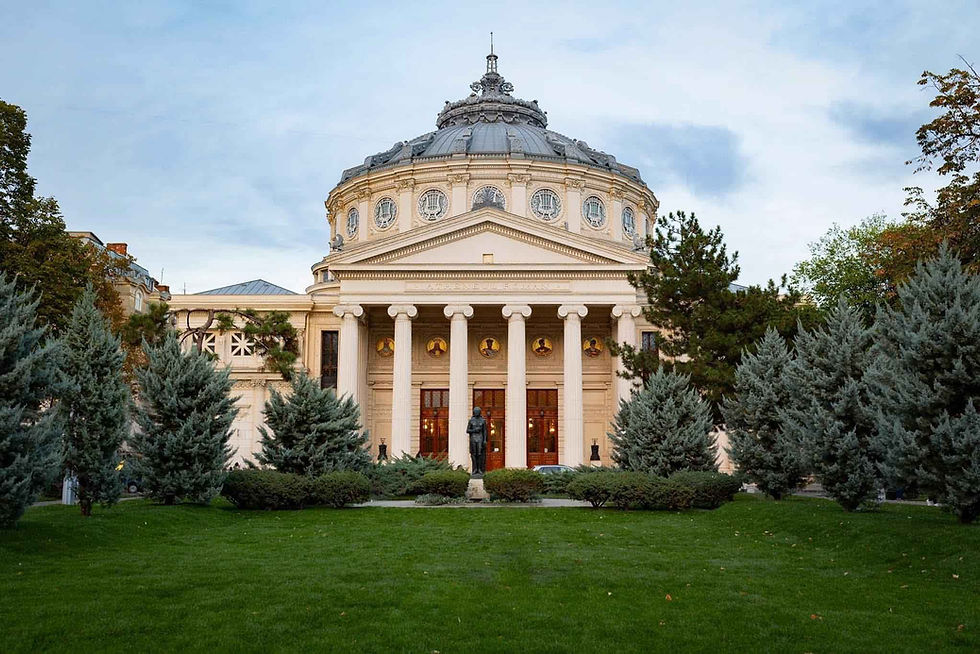
To your left is the Royal Palace (the museum), representing the monarchy. Across from it is the former Central Committee of the Communist Party, where Nicolae Ceaușescu gave his final speech. To your right is the Atheneum, representing the cultural peak of the nation. It is rare to find a single square in Europe where the architectural and political shifts of 100 years are so clearly mapped out.
The "Local Secret" here? Visit the square at dusk. As the lights flicker on at the Atheneum and the museum facade is illuminated, the chaos of the city’s traffic fades into a golden-hour glow. It is the best time for photography, as the shadows accentuate the neoclassical details of the palace, and the tourists have mostly moved on to the Old Town.
Practicalities for the High-End Traveler
The museum is closed on Mondays and Tuesdays, a detail that catches many off guard. To truly enjoy the experience, plan for at least three hours. The museum is large, and the temperature control is excellent making it a perfect escape during the humid Bucharest summer afternoons.
If you are staying at the Athénée Palace or the Marmorosch, the museum is a short, pleasant walk. Wear comfortable shoes, but don't feel the need to dress like a typical hiker. Bucharest is a city that appreciates style. A sharp blazer or a chic silk scarf will make you feel right at home among the locals who treat the museum grounds as their Sunday promenade.
The National Museum of Art is not a relic; it is a living testament to a city that refuses to be defined by its darkest chapters. By spending time here, you aren't just looking at paintings. You are participating in the quiet, elegant defiance of a "Little Paris" that never truly went away.
To truly experience the Atheneum Quarter like a local aristocrat, you must know where to pause between the galleries and the grand boulevards. The area is a dense micro-neighborhood where 19th-century charm meets 21st-century specialty culture.
Here is your curated shortlist of the best stops in the immediate vicinity of the National Museum of Art.


Comments