
The Romanian Athenaeum – Bucharest’s most beautiful building?
Updated: Sep 22
You arrive in Bucharest expecting the rugged remnants of a complicated past, but as you turn onto Calea Victoriei, the city suddenly shifts into something entirely different. Before you stands a domed masterpiece that feels like it was plucked straight from the heart of 19th-century Paris. Yet, many high-end travelers make the mistake of simply snapping a quick photo of the facade from behind a taxi window, missing the deep cultural resonance and the hidden logic of the building’s interior.
In thisGuide:
The Architectural Legacy of a Nation’s Collective Pride
Orchestrating Your Visit: Timing and Discreet Access
Mastering the Experience: The Insider Secrets of the Atheneum
A local tip: visit without a concert ticket
The Etiquette of an Evening Performance at the Philharmonic
Navigating the Surrounding Cultural Triangle
Local Recommendations: Where to Linger Near the Atheneum
For the discerning traveler, the Romanian Atheneum is not just a stop on a checklist; it is an invitation to witness the "Little Paris" era in its purest, most preserved form. To truly appreciate this landmark, you need to understand how to navigate its schedules, its surrounding elite social scene, and the unspoken etiquette that governs Bucharest’s high society.
This is a guide for those who want to move beyond the surface, offering a local’s perspective on how to integrate a visit to the Atheneum into a perfectly curated day in the capital. Whether you are here for a romantic milestone or seeking a solo cultural immersion, the Atheneum is the pulse of the city's sophisticated side.
The Architectural Legacy of a Nation’s Collective Pride
Completed in 1888, the Atheneum is a testament to the collective will of the Romanian people. When public funds ran dry during its construction, a national campaign under the famous slogan "Give a penny for the Atheneum" saved the project. This history of community ownership is why locals hold the building in such high regard; it is not a monument to a king, but to the people's desire for a temple of the arts.
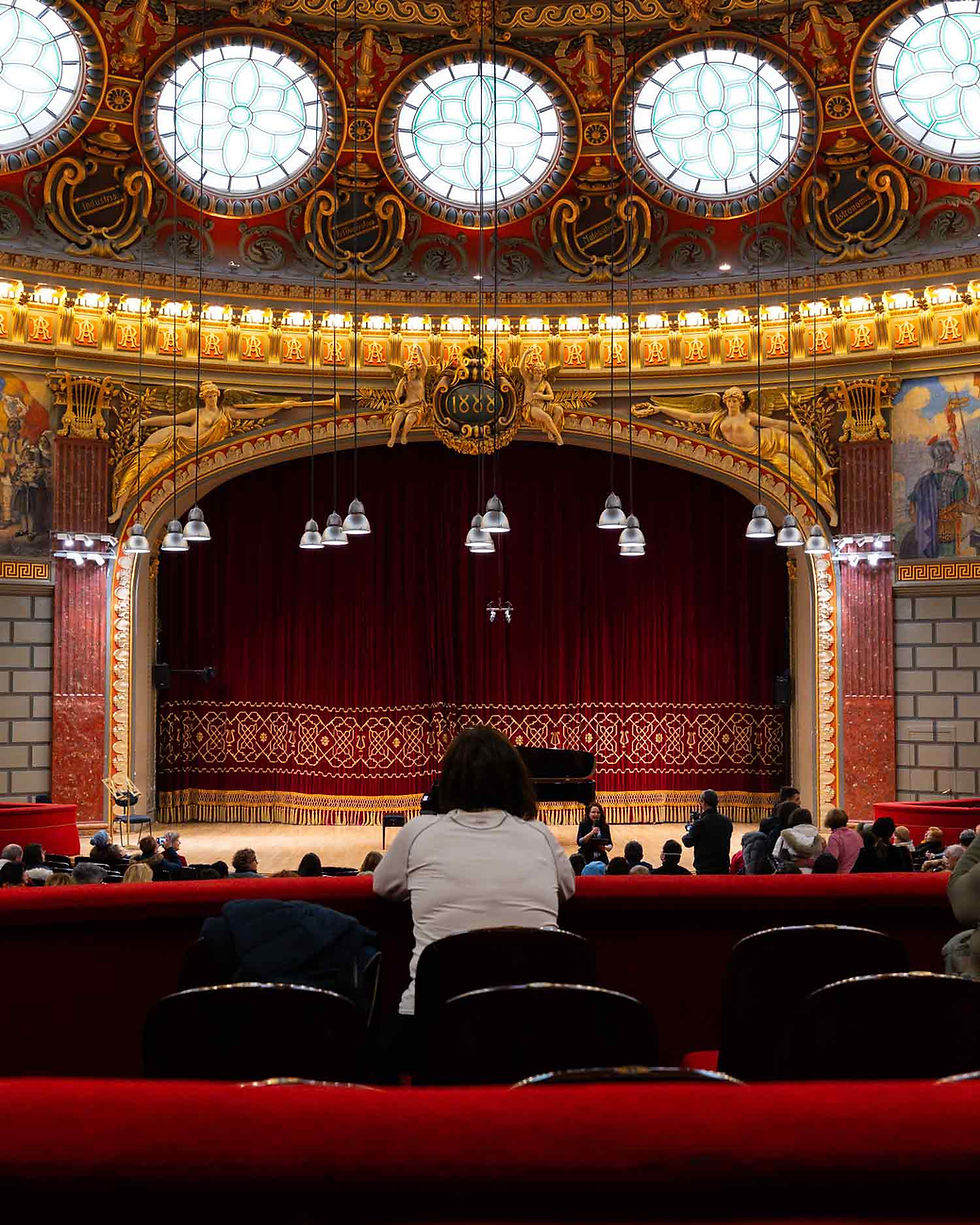
Designed by French architect Albert Galleron, the building is a neoclassical triumph. The towering Ionic columns and the massive dome dominate the skyline, but the true magic is in the circular design. Inside, the ground floor features a forest of Carrara marble columns and grand spiral staircases that feel more like a royal residence than a standard concert hall.
The interior is capped by a spectacular gold-leaf ceiling and a 75-meter-long fresco that tells the story of Romania through 25 vivid scenes. Standing beneath this dome offers a sense of historical gravity that few other European landmarks can match, especially when the light filters through the high windows, illuminating the intricate stucco work.

Orchestrating Your Visit: Timing and Discreet Access
Navigating the Atheneum requires a bit of local foresight. The building is primarily a working concert hall the home of the George Enescu Philharmonic which means access for tourists can be unpredictable and is often secondary to the musicians' needs.
The most common mistake is trying to enter through the grand front doors during the day. For daytime visits, look for the small, discreet side entrance on the right-hand side of the building. This is where you can pay a modest fee (around 10-20 RON) to view the interior. It is essential to carry local cash (LEI) here, as this small booth rarely accepts cards and there is no digital ticketing for casual walk-ins.
The best time to visit for a quiet, contemplative experience is between 10:00 AM and 2:00 PM on weekdays, provided there is no rehearsal. If you hear music muffled through the heavy oak doors, a rehearsal is in progress, and the hall will be closed to visitors. Respecting this boundary is part of the local etiquette; the Atheneum is, first and foremost, a sanctuary of sound.
Mastering the Experience: The Insider Secrets of the Atheneum
While the building is famous, few travelers know about the "Whispering Gallery" effect. Because of the circular architecture of the main hall, the acoustics are so precise that a whisper on one side of the room can often be heard clearly on the opposite end. It is a phenomenon that adds a layer of mystery to the visit, one that is best experienced when the hall is empty of crowds.

Another secret lies in the garden. While everyone stands in the center to get the "standard" shot, the most beautiful perspective is actually from the side alleys near the statue of Mihai Eminescu. From here, you get the layers of the garden’s greenery contrasting against the cream-colored stone of the columns, providing a much deeper sense of scale and elegance.
If you are visiting in the autumn, try to align your trip with the George Enescu Festival. During this time, the area transforms into a world-class musical hub, and the energy around the Atheneum reaches a peak of sophistication that rivals the BBC Proms or the Salzburg Festival.
Transitioning from the historical grandeur of the Atheneum to the modern energy of these local spots is the best way to feel the pulse of the city.

A local tip: visit without a concert ticket
Here’s a small bonus tip many visitors don’t know: you don’t need to attend a concert to see the Athenaeum from the inside.
Outside performance hours, the building is often open to visitors for a very small entrance fee. It’s an easy and affordable way to experience one of Bucharest’s most beautiful interiors.
Service Navigation in Bucharest
The Etiquette of an Evening Performance at the Philharmonic
If you are fortunate enough to attend a concert at the Atheneum, be prepared for a formal atmosphere that has largely disappeared from Western European venues. While the world has become increasingly casual, the Atheneum remains a place where "dressing for the occasion" is a deeply respected tradition.
For an evening symphonic concert, business formal or elegant attire is the unspoken rule. You will see local families in their Sunday best and the city's intellectual elite in tailored suits. Arrive at least 20 minutes early to appreciate the lobby and the frescoed hall before the conductor takes the stage.
Photography is strictly prohibited during performances a rule that is enforced by vigilant ushers who take their jobs very seriously. This focus on the music creates an immersive, old-world experience that allows you to truly disconnect from the digital world and connect with the art. It is a rare luxury in the modern age to be in a room where every person is entirely focused on the sound.
Navigating the Surrounding Cultural Triangle
The Atheneum sits at the center of what I call the "Cultural Triangle." Within a few minutes' walk, you can visit several other sites that define the character of Bucharest. Directly across is the Central University Library, another Beaux-Arts masterpiece. Just steps away is the former Royal Palace, now the National Museum of Art.
This pocket of the city is where the "Parisian" nickname was earned. The wide boulevards, the wrought-iron balconies, and the classical statues create a European atmosphere that is both familiar and uniquely Romanian. Taking a slow stroll through these streets after a visit to the Atheneum is the best way to soak in the city's heritage.
The Romanian Atheneum is more than a building; it is a survivor. Having weathered wars, earthquakes, and political shifts, it stands today as a symbol of Bucharest’s enduring elegance. By taking the time to understand its history and the life that surrounds it, you ensure your visit is not just a sightseeing stop, but a meaningful cultural experience.

Local Recommendations: Where to Linger Near the Atheneum
Service Navigation in Bucharest


Comments